A Sugar Maple Story
{Sugaring in the Suburbs}

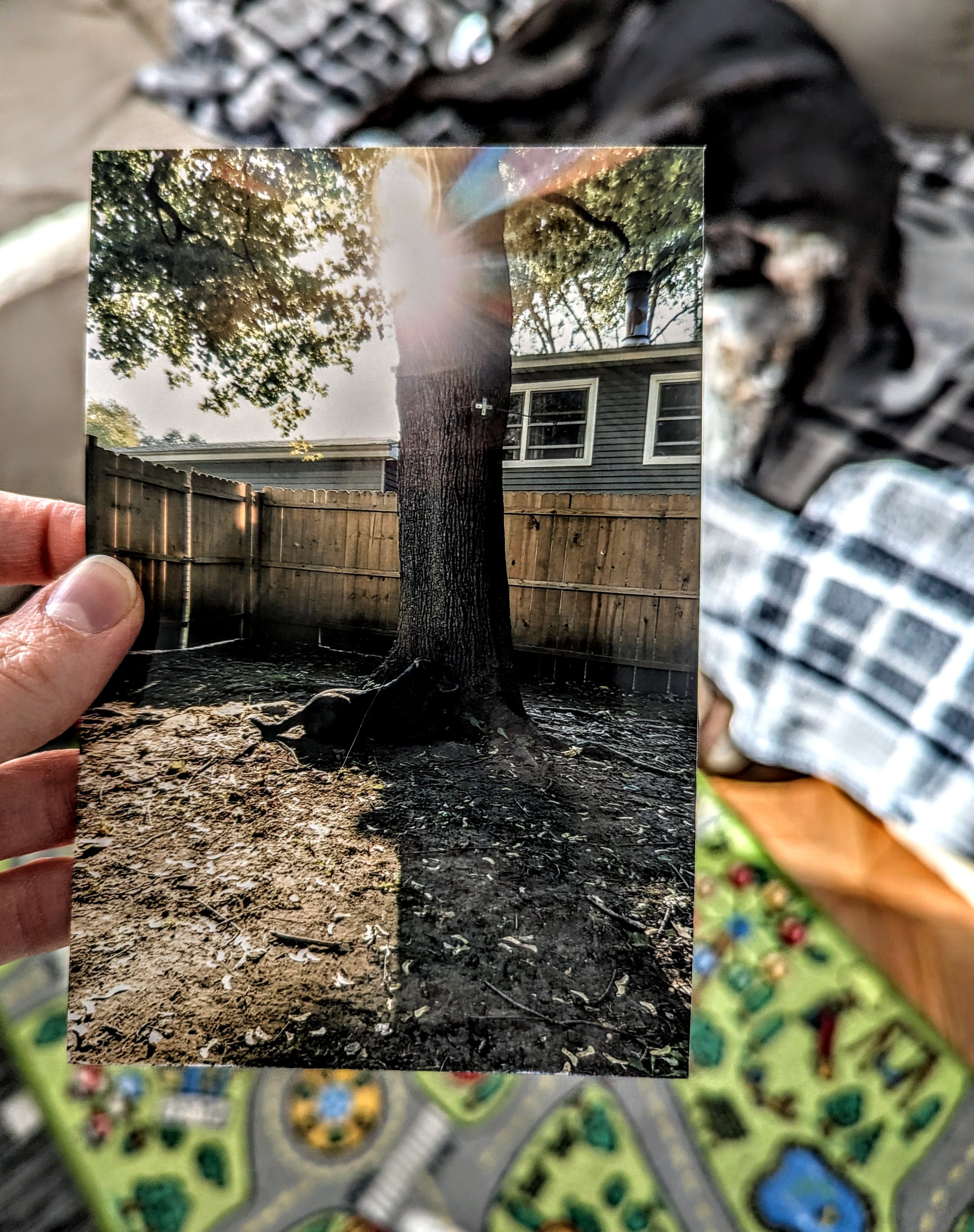
The sugar maple’s long limbs stretched towards the house, gnarled and rough like a grandmother’s arthric hand. It’s stout, furrowed trunk was larger than my embrace. Scars of past maple taps were camouflaged within fissures. It’s shallow roots covered the ground, weaving in and out of the soil like a sea serpent. My dog would lay underneath its canopy on the cool, bare ground, waiting for an unsuspecting squirrel to enter his yard.
Long stretches of concrete sidewalks outlined our neighborhood. Mature silver maples spaced every twenty feet shaded out our lot. We could hardly see the sky through their dense canopies. I didn’t know much about trees at the time, so I figured the maple in our backyard was probably an older silver maple like all the others.
During the fall, after the horseshoe shaped seeds spun down to the ground, huge, multicolored leaves thickly covered our backyard. I noticed that the leaves were fuller and deeper orange than the leaves of the silver maple. These leaves looked just like the one on the Canadian flag, which I knew to be a sugar maple. After a little research, I concluded we had a giant sugar maple on our property. This realization was right around the time that I was dipping my toe into growing and preserving food. I was seeking out local farms for meat, eggs, milk and honey, why not take jump at the chance to make my own maple syrup?
We waited for the conditions to be just right, checking our weather apps daily towards the middle of February. For sap to run, the days must be above freezing and the nights freezing to cause internal pressure. Sap is the equivalent to blood in our bodies. Blood flows out of a cut, sap runs out of a 2” hole.
I had to do a little sweet talking to get my husband to be on board sugaring. You have to understand, we didn’t grow up doing this kind of thing and I guarantee we were the only ones in our city tapping our backyard maple tree.
I bought the supplies, including, a few different plastic taps, two large food grade buckets and plastic tubing.
With trepidation, I directed my husband where to drill the first tap. Straight in! I tell him. No more than 2”. My fear was damaging the beautiful tree. Although, I’m sure it was hardier than I could even imagine. It survived a massive tornado in 1965.
Next, the tap was, literally, tapped into place. Once it was snugly fit, I held my breath. This was my idea, this tree better produce sap! I felt like we struck oil when I saw the sap drip from the tap. Logically, I knew it would, but seeing it for myself was nothing short of miraculous.
The trees diameter was big enough to host two taps, maybe even three, but I didn’t want to be greedy. My husband drilled a hole through each bucket so only the tubing could fit inside. The other end of the tubing fit tightly onto the tap. The sap traveled down the tube into the clean bucket for an easy collection, free of leaves or dirt.
Heres where I am going to lose a lot of people. I boiled all the sap in the biggest pot I had on my stovetop. When the sap got low, I added more sap, until finally, when I had it for the day, I would let it boil down to a consistency that could coat a spoon. Sometimes I let the syrup cook down even more to make a taffy like candy that my son loved.
Word of caution to anyone considering making their own maple syrup, don’t burn it. Once, after a six hour boil on the stove, time got away from me, and I smelled something burning. The syrup burned so bad I had to throw out the pot. I almost cried.
For about two weeks our windows were fogged with condensation and the walls looked like they were sweating. The air was intoxicatingly sweet but in all honestly, I would not boil sap for that long indoors ever again. The reason why we didn’t go the wood fire route is simply because I didn’t want to continusly feed a fire.
Thankfully, the product was absolutely amazing. Hands down the sweetest, most robust maple syrup I have ever tasted. Family agreed as well. Maple sugaring was a fun experience and it made me very thankful for our sugar maple.
I often wondered how it came to be in our backyard. Did someone lovingly tuck the sugar maple into broken sod as a sapling over a hundred years ago? Or did a winged seed float in a perfect autumn wind to find that very spot? I won’t ever know.
I’m guessing the tree was around 150 years old, dating back to the pioneer days when Crystal Lake, Illinois was farmland and forest.
I like a good story, so I imagine the sapling was dug from its home back east, planted in a soil filled burlap sap to travel by covered wagon to a place where the water is clear as crystal. I imagine a young girl’s hands wrapped around it like a pet the entire ride. She had wanted to take a piece of her home with her out west. Every few days, while the horses drank from the river, she cupped her hands and tenderly soaked the soil just enough to keep the roots moist. Her parents rolled their eyes and told her that it won’t be big enough to tap for years. She quietly but firmly told them, it’s for my grandkids, then!
Very rarely do you hear a homesteading family fondly reminisce about the days before they bought the land, before the animals, before the big garden. It feels like a slight to the present to admit missing anything of the past. How can I miss my old house when I dreamed of this exact life I am living? I’ve felt that strange guilt, but I push back because each season of my life holds great value to me. Just because I miss certain aspects of our last home doesn’t mean I don’t love our homestead.
We have gained so much by making a life changing move to northern Wisconsin, but I miss having family close by. I miss being able to walk to playgrounds. I miss my sugar maple in my backyard.
It’s ironic, because the most common tree in Wisconsin is the sugar maple. Our forest is mostly aspen with a few other trees throughout, but not a single maple. I hold a reverence for aspen trees, but I miss my sugar maple. I am happy to support the numerous local sugar bushes in my area. They are easy to spot from the roadside by the blue tubing woven through the woods. But I still plan to plant a bare root sugar maple in the spring, not only for future sap but for their beauty.
When I do plant my tree, if someone feels the need to tell me that my sugar maple won’t be big enough to tap for years, I will quietly but firmly tell them, it’s for my grandkids.
We have 2 maples in our northern NY yard of sufficient size to tap. Every year we gather enough sap to keep us in syrup for a year. Because we do it small batch style, we use the base of our turkey fryer with a large pot to boil right out the back door and finish inside. There is nothing better than home made syrup. Like you said, the best you have ever tasted. Plant the sugar maple my friend. We’re watching the weather app closely…………
Great story — both the nonfiction part and the fiction part!